The 10 Commandments of a Festive Feast: How Not to Overeat?
Overeating – as a sign of our sociability
We overeat quite often. The reasons vary, but most often it is stress, social factors, and nervous or metabolic disturbances. Festive feasts are a classic example of overeating, due to the social factor. There are many scientific studies that indicate our eating behavior depends heavily on our environment. We consume little food in the company of strangers, but tend to eat more than 70% more when we dine in the company of close people. This is especially pronounced when the number of participants at the feast is more than 6. Interestingly, men are more susceptible to this influence.
In experiments comparing the amount eaten alone, with two friends, with two strangers, and in front of a television screen, it was shown that participants who ate with friends or in front of a TV overeaten the most – you recognize our traditional New Year’s feast? :)
We tend to overeat and spend more time at the table when we are in pleasant company. And this is nothing other than a manifestation of human nature – sociability.
What happens when we overeat?
When we consume an excessive amount of food, our stomach stretches too much. It’s unpleasant and painful. And if it happens several times in a row (one holiday after another and a couple of visits to all the guests), we end up with a stretched stomach and an inability to feel full at the usual portion sizes! After all, one of the factors for the sensation of fullness is the pressure on the walls of the stomach! And for a stretched stomach, the same pressure requires a larger amount of food! The good news is that this process is usually reversible, and if you eat smaller portions for a while, the stomach will shrink again.
The upper valve of the stomach sometimes cannot withstand excessive load, and the acidic contents are pushed back into the esophagus, causing its burning, leading to inflammation and erosions. This is how gastroesophageal reflux disease develops.
The lower valve of our stomach also cannot withstand excessive pressure of food and passes portions into the semi-digested form further into the intestines. This is a factor in digestive disorders, in particular flatulence. Under normal conditions, food in the stomach undergoes important changes – it is broken down into components that can later be absorbed by the villi of the small intestine. Also under the action of gastric juice most pathogenic bacteria die, and only acid-tolerant bacteria survive, including lactic acid bacteria. With overeating, undigested and rich in unwanted bacteria mass enters the duodenum and begins to ferment and produce gases.
In the duodenum open the bile ducts and the pancreatic duct. And when we have laid out half a pig with salad Olivier and a bottle of vodka, that eruptive mass, plus the pressure of gases, can be pushed back into the ducts of the pancreas. And this is, at the very least, an acid burn of delicate secretory tissues.
And this is the development or exacerbation of pancreatitis. And, worst of all, its acute form! It leads to an acute pain syndrome, and the feast participant often needs urgent medical help and often urgent surgical intervention! Doctors note a several-fold increase in pancreatitis flare-ups during holidays! And acute pancreatitis is almost always associated with alcohol consumption.
By the way, the cardiovascular system also suffers a lot, as it is closely linked with breathing, and to breathe normally we need a functioning diaphragm. And it is blocked by a bloated stomach!
We must remember that alcohol and caffeine only worsen the situation during overeating – because they dull its symptoms and allow us to eat even more. Here a vicious circle arises, because excessive food also promotes excessive alcohol consumption – we get drunk more slowly, so we tend to drink more. But the body still has to neutralize all that alcohol, and it doesn’t become easier!
Popular and advertised remedies for overeating are enzyme supplements. They can indeed somewhat ease digestion and absorption of the consumed food, but they will not protect your stomach from stretching and pain, nor your pancreas from pancreatitis.
And, of course, overeating will affect your figure and health in the future.
What fears! You will think so and you are right! Therefore below is an effective list of practical tips to avoid this trouble and to remember the feast afterwards with pleasure.
How not to overeat: effective life hacks
1. Don’t stay hungry while waiting for the feast time. If you go to a party, eat something before it. Ideally this “something” should not be a candy or pastry, but should contain protein and fiber. This will protect your stomach from painful cramps from just the smell of Olivier, and also protect you from sudden and inappropriate intoxication!
2. Remember that alcohol and caffeine simply suppress the feeling of fullness — try not to overdo them. Drink in small sips and in small amounts, don’t fall for any invented rules to drink “to the bottom.” You are the master of your body and you are, not someone else, responsible for its well-being!
3. Thoroughly chew your food and try not to overeat in the first 20 minutes of the feast! The sensation of fullness forms in roughly that time frame, and then it will be easier for you to stay moderate.
4. We still want to try all the dishes, right? And there are many! Serve yourself in as small portions as possible on your plate – better to take seconds of what you liked most afterwards.
5. Don’t be shy about sharing a sandwich, cutlet, or dessert with someone – that very small indivisible portion of food is an additional factor for overeating;
6. Take every opportunity to move! Go to the window – watch the fireworks! Help clear the table, dance, or play Twister, Rock-Paper-Scissors, or even snowball fights!
7. Plan the celebration so that food is not the main source of joy! Let it be pleasant conversation, gifts, games, or even your new dress!
8. If you are expecting to be hosted by overly hospitable hosts, ready to feed you the entire annual norm of Olivier and regard refusal as a grave insult and a synonym for “tasteless” (yes, unfortunately, this happens!) - prepare in advance a strategy to repel these attacks. Thank the hostess, praise her, but never go for “another piece of chicken” at all costs! In a pinch, the phrase "the doctor forbade it" or "something makes me nauseous" will help you!
9. If you suddenly realize that you are already full, but your hand still reaches for the table – let it reach... for a glass of water! But just plain water! Sip water regularly if you feel you need to keep yourself occupied while continuing the conversation!
10. Remember and remind yourself mentally that in the morning your body will thank you for every un eaten spoon and every glass not drunk! And as they say, how you meet the New Year... :)
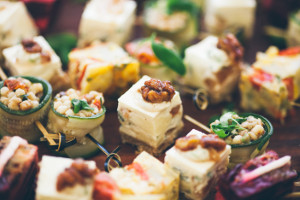
Photo by Kelly Jean on Unsplash