Air Pollution: Consequences and Perspectives
The main polluting components in the air are dust, sulfur, nitrogen oxides, and ozone. In addition, there are also carbon oxides and heavy metals.
Particular attention in the context of the impact on human health is paid to the so-called "PM" (PM 2.5 and PM 10).
Who are PM2.5 and PM10?
PM (particulate matter) 2.5 and 10 — simply put, particles with a size of up to 2.5 microns or from 2.5 to 10 microns respectively. To help imagine it, the thickness of a human hair is about 70 microns.
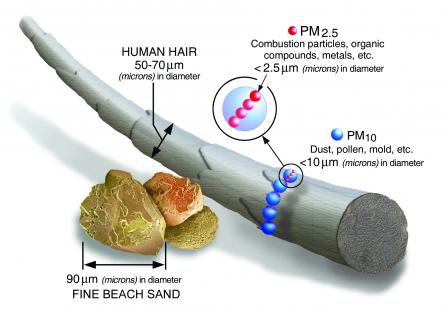
Photo: http://bit.do/fiueT
These particles can have a different nature-air-quality-and-health) and consist of various components — a variety of salts, including heavy metals, soot, dust, liquids. The sizes embedded in their names affect their aerodynamic properties and the way they interact with our body.
Particles with a diameter of 10 are already small enough to enter deeply into the lungs with the air flow, and particles of 2.5 can penetrate from the alveoli into the bloodstream.
Where do they come from?
PM 10 can be formed as a result of many natural processes and often have a mineral nature. Their sources can be, for example, construction sites, unpaved roads, and exposed soils.
The formation of finer particles is associated with processes of burning or chemical transformation of other pollutants — sulfur dioxide, nitrogen oxides. Therefore, their increasing amounts are contributed mainly by industrial emissions, transport, and any smoke.
About smoke: the contribution of tobacco smoke to outdoor air pollution on streets can sometimes exceed the contribution from motor vehicles.
This is especially noticeable on streets with tall buildings where a sort of "canyon" is formed and air exchange is slowed. Researchers measured PM particles in pedestrian zones and zones of heavy traffic and found a worse air condition in the evening in the pedestrian zone precisely due to tobacco smoking. Today smoking is banned on the streets of Japan, in the parks of many US cities.
Smoking hookahs is no better, as the air quality index indoors where hookahs are smoked exceeds 300 units, which corresponds to the highest level of danger according to the air pollution levels classification.
Polluted air from hookah bars makes its way outside, which has an impact on public health — these conclusions were made by British researchers (yes, they are indeed British and studied air in restaurants in Birmingham). And it’s a pity that they did not see Kyiv’s streets in summer, where cafe-goers on open terraces often smoke hookahs right in the faces of passersby. Incidentally, in these studies only a quarter of cafe staff with a hookah menu suspected possible harm to their health simply from being at their workplace.
And about indoor air. Do not overdo candle burning and incense sticks. Also remember to use ventilation when using a gas stove.
Why is this important?
One might think that there are so many dangers in the world, why would some tiny particle a few micrometers in size cause serious concerns?
However, numerous studies claim that there is indeed cause for worry, and the matter is not only that sensitive groups feel throat irritation. Under the action of these particles there can be a disruption of the barrier function of the nasal epithelium. This reflects in an increased frequency of rhinitis and rhinosinusitis in more polluted areas.
PM2.5 can accumulate in lung tissue, cause local damage, inflammatory processes, and penetrate into the bloodstream. As a result — increased susceptibility to infectious respiratory diseases, asthma, chronic obstructive pulmonary disease, fibrotic formations.
There are already convincing data on the impact of air pollution and PM itself on the incidence of lung cancer, as well as its link to the incidence of bladder cancer.
Therefore, recently air pollution and PM particles have been classified as carcinogenic.
Research indicates that PM2.5 increases morbidity from cardiovascular diseases and mortality from them both with short-term and long-term exposure to these particles.
Short-term episodes of deteriorating air quality are not left unnoticed by clinicians — the number of calls related to respiratory complications and heart attacks significantly rises. The incidence of ischemic heart disease in middle-aged people is increasing.
PM2.5 provokes local and systemic inflammation, is a factor of oxidative stress and coagulation disorders, damage to the vascular endothelium.
Acute exposure to PM2.5 increases the risk of arrhythmias and, accordingly, their consequences. Such an effect is more pronounced in people with hypertension.
The action of these polluting particles [affects fetal development]. Higher concentrations of PM2.5 in the last trimester of pregnancy may increase a child’s susceptibility to respiratory diseases during the first year of life. There are also data on the impact of these particles on the development of congenital [hypothyroidism].
Today there is discussion about the delayed health effects of polluted air on people, for example shown that PM2.5 causes changes in the brain that lead to memory deterioration.
What to do, where to run?
- Monitor air pollution indicators. And do not go running if they rise. Avoid excessive time outdoors, especially if you have existing cardiovascular diseases.
- Try to plan routes to avoid busy streets whenever possible.
- A good solution for indoor spaces — air purifiers.
- Avoid other cardiovascular risks — tobacco and alcohol.
- Avoid smoky indoor environments, including from tobacco and hookahs.
- Prefer public transport over private, and when choosing private transport — follow ecological safety standards.
What to demand?
The situation with worsening air quality unfortunately cannot be solved without an active public position and a systematic, decisive legislative impact.
Therefore the following steps are necessary-air-quality-and-health):
- proper air quality control at a modern level;
- control of industrial and transport emissions;
- promotion of infrastructure for cycling and electric transport;
- restrictions on tobacco smoking and hookah smoking on streets and in other public places;
- control and prohibition of burning leaves and other waste.
Photo by Steve Halama on Unsplash