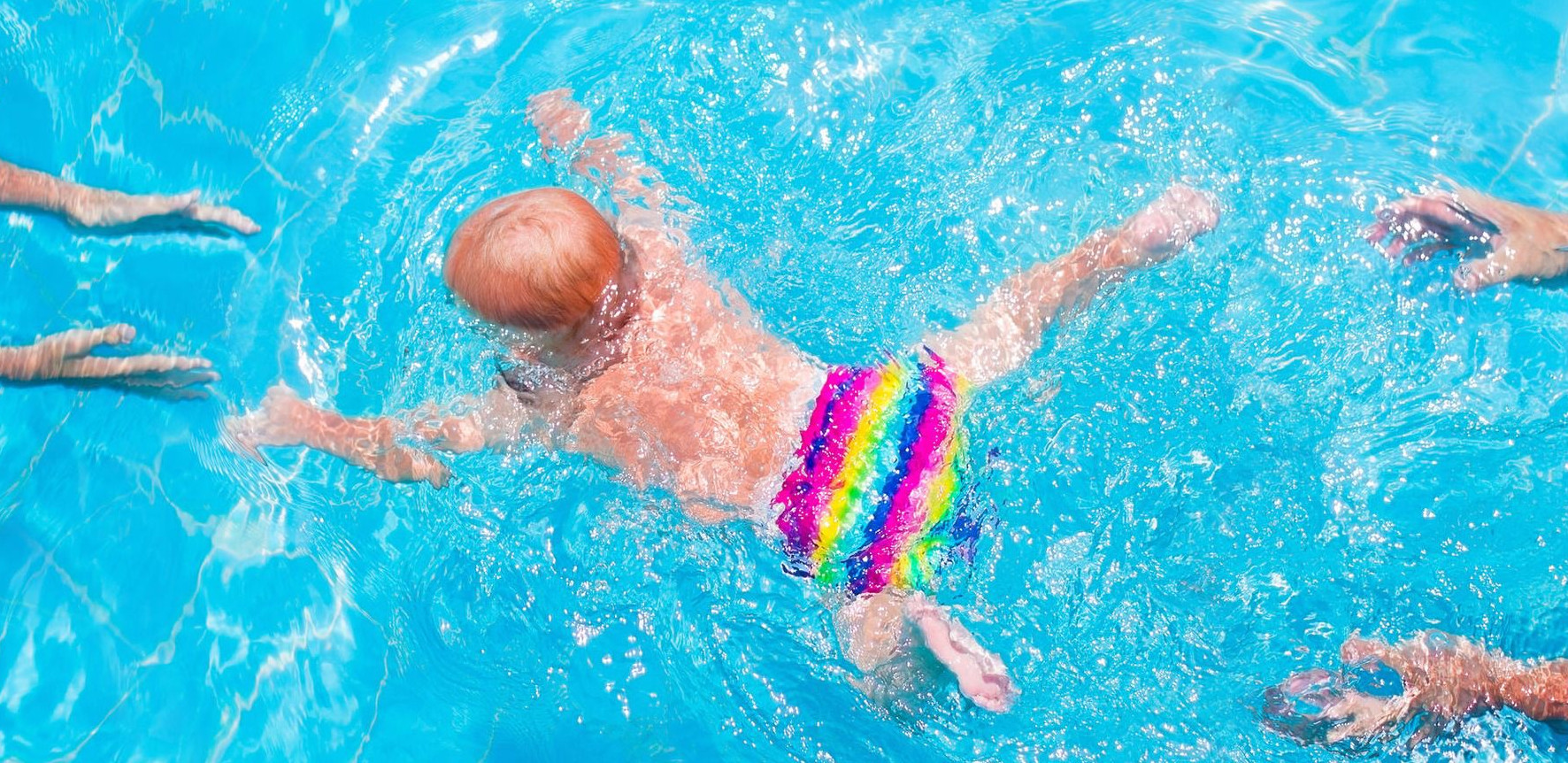
Early swimming – benefit or fashion?
This very reflex consists in the fact that when the face is submerged in water, there is a breath-hold and a slowing of the heart rate. This reflex is characteristic of many mammals and is pronounced in children up to six months old. Also, children when submerged in water wave their arms, which can resemble swimming motions. This, as well as bright photos of babies underwater that fill blogs, social networks, and advertisements for recreational facilities, creates an impression of the importance of such procedures.
In recommendations it is stated that early swimming develops the musculoskeletal system and is beneficial for mental health. This is a very convenient argument in fact, because a child’s musculoskeletal system is already actively developing, and the impact on mental health is, above all, relevant for parents. For them, such activity is an element of variety, as well as a way to experience a new social status.
But can we imagine, for example, a female chimpanzee dunking her infant in water “to develop the musculoskeletal system”? It sounds a little doubtful, you must agree. So perhaps it is worth evaluating the existence of such reflexes as one of the protective mechanisms, rather than a call to raise a generation of freedivers?
Why could this be dangerous?
First, as banal and frightening as it sounds — a child can choke or be injured. Very young children still cannot consciously hold their breath and are not strong enough yet to keep their head above water. And when water gets into a baby’s ear, the infant is unlikely to tell you about it in any way other than crying. Also, in recommendations’ descriptions, it is often reminded that water procedures should be carried out when “the child is in a good mood and positively inclined.” But how many parents, having come to the pool, paying for the visit and the instructor’s services, and seeing that the “child is not in the mood,” will refuse the idea of dunking them?
Not to mention that during such “swimming” the infant can swallow a lot of pool water.
The fact that the pool water is not very clean is not surprising to anyone. More details about the biodiversity often found there can be read in our previous post. We will also add that children’s swim diapers can only contain hard stools, but they are by no means equipped with bacterial filters :). Moreover, we found a publication by a group of American researchers who showed that swim diapers also do not retain larger particles, such as oocysts of Cryptosporidium. In modeled experiments, after just 10 minutes of immersion, almost all microspheres of a similar diameter (the Cryptosporidium oocyst model) were released into the water (1).
Let alone other possible enteric infections.
And in infants under one year who DID NOT attend a pool, lower rates of diarrhea, otitis, and respiratory infections were observed, compared with their “swimming” peers (2, 3).
Recent years’ research reveals many interesting facts about the consequences of early swimming. In particular, it was shown that the hardness of pool water is associated with a threefold increase in the risk of eczema in children (4).
It is known that in the blood and urine of adult swimmers after visiting a pool, toxic chlorine- and bromine-containing compounds are detected, which enter the body not so much through the skin as by inhalation. And in children, especially infants, the barrier function of many systems is not yet established, making them more vulnerable to toxic substances (5).
One cannot fail to mention the irritating effect of pool water on the mucous membranes of the eyes and nose, familiar to many adult swimmers, and what can we say about the delicate immature epithelium of infants! Therefore, early swimming is associated with subsequently more than a 4-fold increased risk of bronchitis, as well as asthma and allergies (6, 7, 8).
The General Health Council of Belgium strongly recommends refraining from swimming for children under a year old, pointing to the possibility of starting such activities from 3–4 years old (9).
The American Academy of Pediatrics and the American Centers for Disease Control and Prevention remind that there is no scientifically substantiated data on the safety of existing infant swimming programs and urge weighing potential benefits against risks — hypothermia, infectious diseases, and damage to respiratory tissues by pool chemicals (10).