Evidence-Based Medicine for Dummies – What Do We Get From It?

Photo by Martin Brosy on Unsplash
Evidence-based medicine, judging by its very name, implies the presence of some kind of evidence. Specifically – evidence of its effectiveness. This is a fair principle for both the life and health of the patient and their wallet.
Do we want medications prescribed to us simply on the basis of a good story at some pharmaceutical conference, beautiful advertising, or dubious results obtained by someone on 6 rats?
How exactly to spend money and time is always our choice, and it’s good when there is plenty of time and money. But often delays and treatment with junk (the word everyone liked!) can lead to a worsening of health – even so that time runs out too soon.
So:
Where do those medicines and practices with proven effectiveness come from?
Your doctor makes decisions about recommendations based on his clinical experience, the latest evidence in medicine, and the individual characteristics of the patient. This is the "holy trinity" of evidence-based medicine. 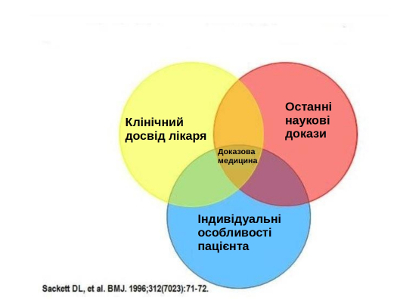
With experience and individual characteristics, things are roughly understood.
And what exactly is evidence?
Intuitively, we probably understand the difference between “I like this drug” and “the effectiveness of this drug has been demonstrated in thousands of patients, about which is written in this scientific publication”?
Evidence is always a solid argument and reference to specific authoritative scientific sources!
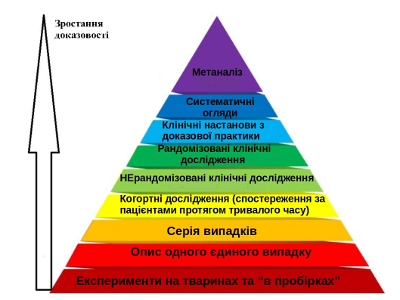
At the same time, evidence can vary and depends on the degree to which particular clinical situations have been studied. This can be relatively easily understood from the pyramid below. Each level is a separate type of research with its own design and data analysis methods. The quality of this evidence increases toward the top.
The higher the level, the less information can be found, but its value is higher! This process can be compared to filtration of the superfluous.
And who creates this evidence?
Behind these studies are thousands of scientists, doctors, medical and scientific institutions, as well as patients, resources, and funds allocated to the development of science and medicine by leading world governments and foundations. Currently, this is a confident, stable process of gradually exploring the most subtle features of the human body and mind.
Medical science no longer turns the world upside down with every loud breakthrough. The era of upheavals has passed with its heroes and villains. Yet echoes of that time can still be found in some headlines that, unfortunately, sometimes read, "Scientists have found the secret of eternal life."
What does this mean for us, as patients?
When choosing your doctor, an important criterion is their active stance toward evidence-based medicine – this will affect the efficacy of treatment and significantly save your money;
And also — truly, no one can take away our belief in the sacred arnica or holy water for soothing the soul (if it is so unsettled), and for peace of mind, nobody will forbid applying them to the affected area (and perhaps the placebo effect will work, which, by the way, is not always good either).
But we must always clearly realize:
the difference between remedies with proven effectiveness and those without,
our responsibility for our health and the health of our children when choosing such remedies,
the futility of spending money on "miracle remedies," the effectiveness and safety of which are not proven in any way.
We wish you to deal with highly qualified doctors, to always find common ground with them, and also to have access to high-quality constructive information!