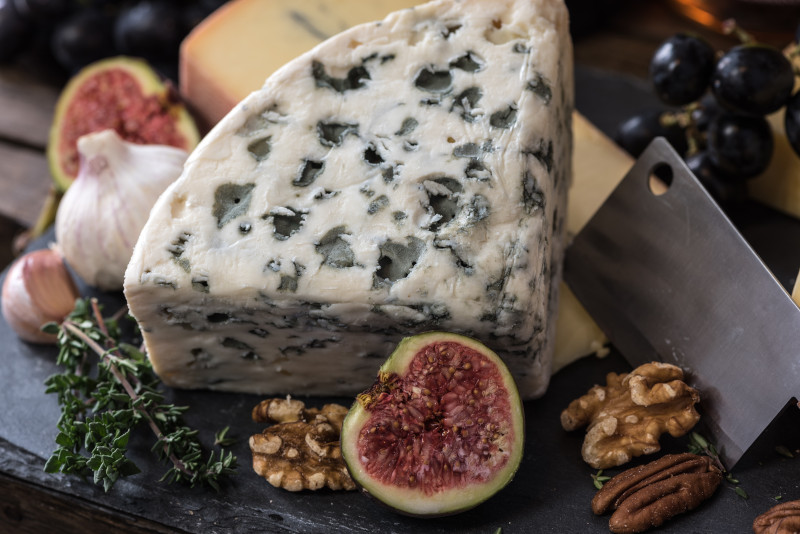
Blue Mold Cheese: About Taste and Safety
The process of making mold-ripened cheeses deserves its own adventure novel and can happen in really quite varied ways. Here we encounter fairly exotic techniques! For example, the aging of some cheeses can take place in reservoirs buried in the ground, or in caves of volcanic origin. Indeed, here you will find anything that brings the conditions closer to what is necessary — so that the "right" mold lives well and comfortably.
Three main processes involved in the production of such cheeses are: the fermentation of milk sugar (lactose) to lactic acid, the hydrolysis of milk fat to fatty acids, and the stepwise proteolysis: milk protein casein breaks down into peptides (short chains of amino acids), and then into amino acids. It is the fatty acids and amino acids that become precursors to the compounds that cause the smell and flavor of aged cheese.
We cannot resist some beautiful details. The bitter taste of cheeses is not due to fat rancidity, but to partial proteolysis: when its intermediate products accumulate, namely peptides. It is some peptides (and if you want even more detail — those with a lot of proline, at the N-terminus of the molecule — arginine or lysine, as well as a higher overall content of hydrophobic amino acids) that have a more bitter taste.
Geotrichum candidum does a wonderful job for them, thanks to its enzymatic abilities it is a desirable guest of many starter cultures for making mold-ripened cheeses.
This microscopic fungus not only breaks down those bitter peptides but also exhibits antagonistic effects toward some pathogens, including Listeria and Mucor. And if along the path of this Geotrichum there are many sulfur-containing amino acids, for example, methionine, then we will have the smell and taste of garlic or cabbage.
Are there antibiotics in blue cheeses?
Despite the grand name of Penicillium, antibiotics are not produced by many species of fungi of this genus. In fact, the famous and life-giving penicillin is obtained from fungi of the species P. chrysogenum. Besides it, the genes for penicillin synthesis have been found in P. nalgiovense and P. griseofulvum.
For mold-ripened cheeses, other penicillia are used — P. camemberti, P. roqueforti, P. candidum. They have neither antibiotics nor genes that could encode them none.
And toxins?
However, mold is mold, and it is hard for it to fully shake off its bad habit of synthesizing at least some poison. For example, P. roqueforti can form a number of mycotoxins, but their amount in cheese is negligible.
And those toxins that are synthesized in larger quantities (for example, PR toxin) do not last long and decompose while the cheese is aging.
Nevertheless, from this point of view, it is worth being cautious when consuming “too authentic” cheeses and still prefer producers who work with bacterial starters. Because “sour by itself” and “ripe, from what fell from the ceiling of some cave” is not always a guarantee of safety. It is quite possible that some wild strains of mold can produce more toxins.
And other biological hazards?
Mold-ripened cheeses belong to the so-called soft cheeses group. And that means the moisture content of such a product is conducive to bacterial growth. And there are many of those!
First, some of these cheeses may be made from raw milk. The CDC authoritatively warns us that the risk of contracting listeriosis or related illnesses is markedly higher when consuming soft cheeses made from unpasteurized milk.
However, researchers note that pasteurized milk is also not a 100% guarantee against Listeria, because sometimes the production of such cheeses, to put it mildly, is not very sterile. Listeria can contaminate cheese during aging and they thrive at low temperatures and patiently endure those 60 days of aging.
Is there any benefit?
Blue cheeses are a marvelous delicacy. It is hard to talk about direct health benefits, but there is a view that their consumption may be associated with some protective effects on the cardiovascular system. Some metabolites of P. roqueforti may contribute to lowering cholesterol levels.
So, here are a few brief summaries.
Blue cheeses: safety rules
This is undoubtedly tasty and inspiring! But, as always, a little admonition — don’t overdo it.
- Because they are fairly salty, and as is known, too much salt is not good for you;
- Remember listeriosis, Salmonella, and other risks of soft cheeses. We should avoid them entirely during pregnancy, in immunocompromised states. It is not advisable to offer them to young children or to people of very old age.
- Try to choose cheese made from pasteurized milk.
- It is worth assessing risks when purchasing various exotic cheeses and from lesser-known producers.
A somewhat humorous question: how to understand that a mold-cheese has indeed spoiled?
We pay attention to the color of the mold. It should be more or less uniform and in accordance with the type of cheese. If pink shows through from a green mold, or orange from white, such cheese should not be eaten. You should also refrain from consuming the cheese if there are changes in texture, mucus or spots appear, or there is a sharp smell of ammonia.