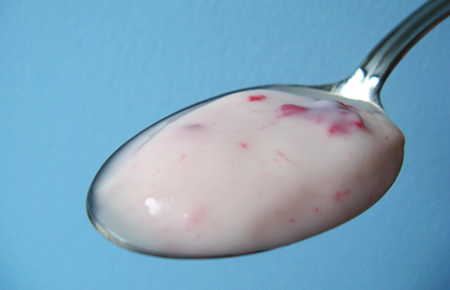
What’s scarier in yogurts?
Why do we have doubts?
Often because we pick up an appetizing bottle, look at the label and see there… a lot of “everything.” A long list of ingredients with alarming names frightens picky shoppers, for whom yogurt is a health-food and a slim figure attribute.
Therefore the most convinced followers of morning jogs, those with strong willpower, and authors of video blogs on healthy lifestyle bravely choose a simple two-component yogurt (milk, lactic acid bacteria) without filler, or make it themselves at home.
What and why is included in a filled yogurt and is it scary?
As already mentioned, the main components of yogurts are milk and lactic acid bacteria. Other possible additional components may be fruit (and not only) fillings, ingredients to improve the consistency (thickeners), flavorings, colorants, fortifying elements, sugar.
Let’s start with the thickeners. Most often these are various types of starch, carrageenan, pectin or xanthan gum, and sometimes gelatin and even semolina. The main purpose of adding these components is to give the product a pleasant texture and appearance. We can say whatever we want about “it doesn’t matter to us,” but when it comes to buying, the consumer prefers a product with a thicker consistency, and the producer makes what sells. By the way, if the same texture is achieved by fat content, then, first, it will affect the price, and, second, it will significantly increase calories and saturated fats.
Some thickeners, like starches or semolina, are digested by us and absorbed as additional calories (don’t panic, there aren’t that many), while others — carrageenan, pectin or xanthan gum — are sources of dietary fiber and treats for our microbiota. By the way, about carrageenan, it is written that its reputation isn’t perfectly spotless, but to cause the pathologies mentioned in one publication you would have to eat quite a lot of it — probably more yogurt than anyone could manage. Pectin and xanthan gum are even sold as separate food additives that aid better bowel function. And as for gelatin, it is also a source of amino acids.
Flavorings — accordingly, provide a more pronounced and stable aroma to the product. By themselves these additives are not harmful. Besides, in excessive amounts they make our sensations a bit more intense and, likely, prompt us to eat more.
Among colorants beta-carotene or beet juice are often used, which, agreeably, is not bad at all.
Fortifying components are a newer, one might say even fashionable direction in the food industry. This is enriching the product with various beneficial substances — mostly vitamins and fiber.
And now about the scary stuff
Which component haven’t we mentioned yet and which is present in all yogurts with fillings (and sometimes even without)? Sugar. Sometimes — up to 18%. None of the above components comes close to the “unhealthiness” of sugar in such amounts. Its insidiousness lies in the fact that we often don’t think about it. Because when we drink tea, adding or not adding sugar is a conscious choice, and many products we consume contain so-called added sugars. And when we eat sausages with ketchup, or pastries, we somehow suspect that this might not be the healthiest food. But in the case of yogurt, we expect exactly the opposite — health benefits.
In 2015 WHO called for all countries to reduce sugar consumption, which is a factor in many diseases — type 2 diabetes, cardiovascular diseases, obesity, and dental caries. Experts emphasize the danger of added sugar, which consumers often simply do not suspect. It is strongly recommended to reduce sugar intake to less than 10% of daily calories, which is a critical threshold and linked to a high risk of certain diseases. A desirable limit is less than 5%.
A few numbers to understand: 10% of a 2000-calorie diet is 200 calories, or 50 grams, or 12 teaspoons. 5% is, accordingly, 100 calories, or 25 g, or 6 teaspoons (remember, these are average figures; we all have different weights). What follows?
If a 500 g yogurt contains 12 g of sugar per 100 ml, then the whole bottle has 60 g of sugar, which already exceeds the critical limit. We haven’t even had coffee with a pastry yet, and we’ve only “healthily” sweetened yogurt.
... And now most people who have read to this point will think — “oh dear, how they’re tormenting us!”
In fact, it wouldn’t be entirely fair to the manufacturers. Because they make what sells, what we prefer. We like to treat ourselves with something sweet, and after chocolate and pastries, a less sweet yogurt might seem bland and uninteresting. Our receptors adapt and get used to higher sugar concentrations, they become “dulled,” and less sensitive. Good news — this process is reversible. If, for a period, we limit sugar and sweets, in about a week or two we can taste the world anew.
But enough poetry — what to do with yogurts?
First — look at the sugar content on the package (by the way, this is relevant not only for yogurts). Many countries have introduced labeling rules that provide a separate line — added sugars. In our country, unfortunately, this is not mandatory yet, though some manufacturers also practice it. Accordingly — choose the one with the lower sugar content.
And we also propose to take an active civic/consumer stance — choose your favorite yogurt that you would like more if it contained less sugar, call the manufacturer’s hot line (the phone number is on the product packaging) and politely express your wish to reduce the sugar content! Accordingly, if there is demand, there will be supply.
Where are yogurts the best?
And finally — for yogurt lovers, results of a mini-study — a review of yogurts from Ukrainian shelves and shelves of some other countries.
We compared the sugar content and information about the presence of live lactic acid bacteria on the labels of 25 Ukrainian yogurts and 31 yogurts from other countries (Germany — 11, USA — 5, Czechia — 4, Switzerland — 3, Poland — 3, China — 2, Austria — 1, Israel — 1, Canada — 1). We should note that data are very limited and do not cover the entire range that actually exists. It is better to view this as a snapshot that nonetheless allows us to see some interesting facts. For example, in Germany and the United States it is hard to find yogurt with live lactic acid bacteria. The highest sugar content was in US yogurts — up to 17–18%! The lowest sugar content among yogurts with fruity fillings was observed on Polish labels — 9.5–10.7%. The presence of live lactic acid bacteria was indicated on Czech, Polish, and Chinese yogurts. Interestingly, in Chinese yogurts the number of bacteria is reported to be ten times higher (108) than what is required in our country (107).
According to the requirements and as indicated on the labels, all Ukrainian yogurts examined contained lactic acid bacteria. Sugar content varied — about 10–11% in children’s yogurts, 12.8–15.6% in the rest of yogurts with fruit fillings.
To sum up — in our products, at minimum, there are live lactic acid bacteria and that’s great! The sugar situation leaves something to be desired. But we’ll change it, right? :)